Cape Town – and surrounds – is one of South Africa’s most historically significant regions. Not only was it the home of the Khoisan people long before the European settlers arrived – but it was also the first refreshment settlement station, established in 1652.
Not all of the Cape’s history is pleasant (in fact, much of it is fraught with battles, slavery and devastating Cape storms) – but it is still important. Especially as it has influenced both our modern-day country and city.
History has always fascinated me, so whenever I travel, I seek out historical places, facts and places of interest. In this post, I share some of the best historic highlights to unearth in Cape Town and surrounds.
Historic Highlights to Unearth in and around the Mother City:
1) The Castle of Good Hope

Built by the Dutch East India Company (DEIC) between 1666 and 1679, the Castle of Good Hope is South Africa’s oldest surviving colonial building. It is a 17th century bastion fort that “was declared a national monument (now a provincial heritage site) in 1936”.
Following its restoration in the eighties, the Castle is considered one of the “best preserved examples of a 17th century architectural structure in the entire world”.
While the Castle has a dark, contentious history in many respects, it remains an important piece of both Cape and South African history.
Today, visitors can widely explore the Castle. You can step back in time, reliving key ceremonies, cannon firings and much more within its lemon yellow walls.

History within its Walls
Other historic highlights within the Castle itself include the original bell tower (built in 1684), which is the oldest in South Africa and weighs some 300 kilograms; the Cape Military Museum and the William Fehr Collection, where you can see incredible fine art and paintings with key Cape significance.

The Castle is one of the most fascinating pieces of history in Cape Town. I love that it has retained so much of its old-world charm and historical secrets.
For my review of the Castle, please see here.
For more insight into the Castle and other visitor information, please see here.
2) Cape Point and Cape of Good Hope

Thanks to its location along the fierce Cape Peninsula and coastline, Cape Point has a long, rich Cape history.
When Portuguese explorer, Bartolomeu Dias became the first to round the peninsula in 1488, he dubbed it the ‘Cape of Storms’. This was due to its infamously treacherous weather (something anyone who has lived through a Cape Storm can attest to).

A decade later, Vasco da Gama sailed this same route, securing a new trade route. With the promise of new trade opportunities between Europe, India and the Far East secured, King John II of Portugal renamed it the ‘Cape of Good Hope’.
The Tale of Two Lighthouses at The Point
The Point, as it became known, has always been treated with fearful respect among sailors. By day, it has served as a navigational landmark. While by night and with fog encompassing it, it turns into something of a siren’s call.

In 1859 on Da Gama Peak, the summit of Cape Point, the original lighthouse was erected. However, its location rendered it ineffective. So, in 1914, a newer lighthouse was built 87 meters, rather than 238 metres, above sea level.
Although, both lighthouses still stand, the old one is used as a “central monitoring point for all lighthouses in South Africa”.
This newer lighthouse is the most powerful lighthouse along the South African coast. It emits three flashes every thirty seconds.
Today, you can visit the old lighthouse for a giddying view of the coastline and jagged cliffs below.
The Cape of Good Hope
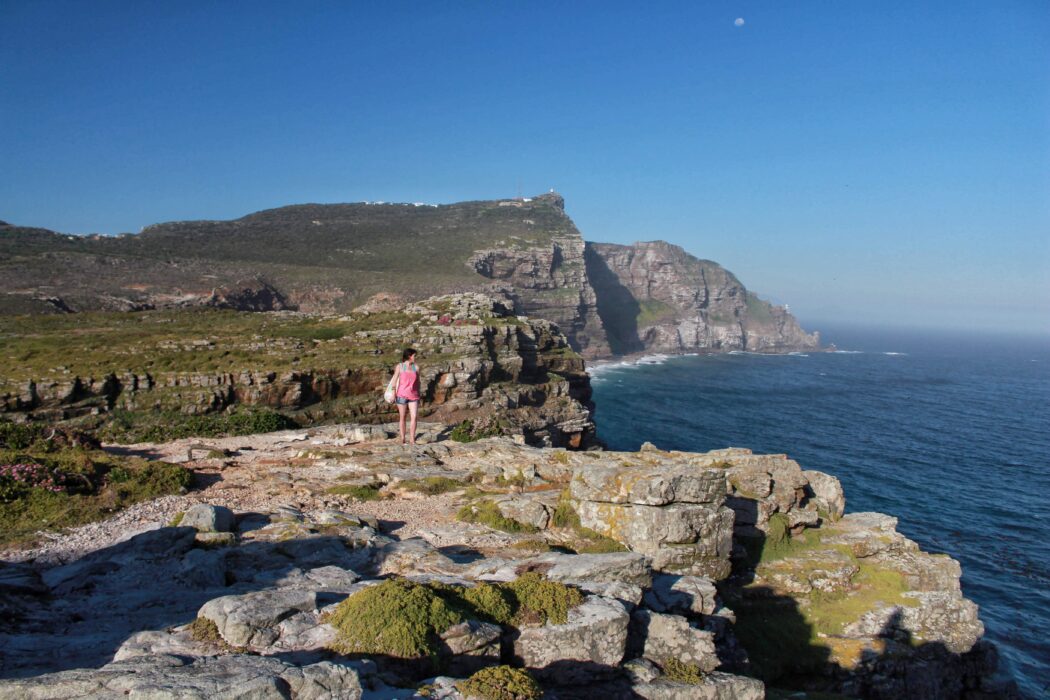
Aside from the natural beauty, Cape history (including monuments that honour the Portuguese settlers) and other modern attractions, one of the natural historical highlights within Cape Point and the Cape of Good Hope Nature Reserve is standing at the Cape of Good Hope, the most southwestern point of the African continent.

Honestly, the Cape of Good Hope section of the reserve is one of the most underrated highlights, yet it provides an amazing experience.
You can read my review of this experience here.
For more information on Cape Point and the Cape of Good Hope, please see here.
3) Wine Farms with Rich Cape History
Many of the Cape’s wine farms have an incredibly rich history. Some of the most historic that spring to my immediate mind are the likes of Blaauwklippen, Groot Constantia, Plaisir de Merle (now known as Plaisir Wine Estate) and of course, Vergelegen.
Blaauwklippen

This Stellenbosch estate is one of the oldest estates around, particularly in Stellenbosch. In fact, it was established just three years after Stellenbosch itself.
Some of the farm’s oldest buildings include The Jonkershuis (built around 1720), the old wine cellar (built in 1707) and the Manor House (which is dated as 1789 but may be a decade or two older). Even the farm’s beautiful oaks are estimated to have been planted around 1770!

For more on the estate’s history, please see here.
Groot Constantia
View this post on Instagram
Groot Constantia is famously South Africa’s oldest producing wine farm, dating back as far as 1685.
Cape governor, Simon van der Stel proudly established the farm and its resulting wine grew in popularity, reaching distant shores.
In fact, the story goes that even rulers such as Frederick the Great of Prussia and Louis Phillipe purchased ‘Constantia Wyn’ at European auctions. The wine is also favourably mentioned in Jane Austen’s Sense and Sensibility and Charles Dickens’ The Mystery of Edwin Drood.
For more on the estate’s history, please see here.
Plaisir de Merle

2026 note: The estate, which has undergone a major rebrand in recent years, is now known as Plaisir Wine Estate. Some of their offerings and attractions have changed, fallen away or been enhanced. My experience was based off the estate as it was at the time of my visit.
Situated near Franschhoek, this estate also enjoys a rich winemaking- and Cape-history. The manor house, built in 1764 by Jacob Marais, is one of the oldest and finest examples of Cape Dutch architecture.
As the farm enjoyed success, in 1705, Claude Marais (Jacob’s son) took over the farm’s management and “declared 8000 vines and 6 leaguers of wine”.
Many of the outbuildings, including the wine cellar, date back to the 1800s and another special feature on the estate is the beautiful old water mill. This is a touching replica of the one Jacob built for his wife, Maria, in 1730.

For more on the estate’s history, please see here.
Vergelegen

Tucked away in Somerset West, Vergelegen is one of the Cape’s most beautiful, historic wine farms.
Founded on 1 February 1700 by Willem Adriaan van der Stel, Vergelegen has enjoyed several ownership eras over the years. Yet, one thing has always remained true: its history and natural beauty has been preserved and cherished.

The residential homestead dates back to the 1700s but it is the gardens at Vergelegen that really fascinate me. In 1987, a team was commissioned to restore the gardens to the “historic core of the estate” and all these years later, the results continue to wow.
Vergelegen is always adding new touches to the estate, while preserving the old and showcasing both the good and bad aspects of Cape history in a poignant, yet respectful manner.
For more on the estate’s history, please see here or visit the estate for a Heritage and Garden tour.
4) Historic Towns in the Western Cape

The Western Cape is home to a plethora of historic small towns. Virtually every town in the Cape is significant and offers a rich Cape history. However, some of the most historically fascinating and popular include places like Montagu, Tulbagh and the Riebeek Valley.
Most of these towns are close enough to Cape Town to enjoy as a day trip or a weekend visit, if preferred.
Tulbagh

Tulbagh is South Africa’s fourth oldest town. Encircled by mountains, canola fields and picturesque wine farms, this small town is also one of the most beautiful around.
What makes Tulbagh truly unique, though, are the number of well-preserved and/or restored Cape Dutch national monuments.

Historic Highlights in Tulbagh:
One of Tulbagh’s most famous, important parts is Church Street. Here, you find South Africa’s largest collection of Cape Dutch, Victorian and Edwardian provincial heritage sites.
The street includes of fascinating mix of public buildings and esteemed private residences.

Another interesting, yet upsetting aspect of the town’s history is the infamous 6.5 magnitude earthquake that struck the town and surrounding Boland Region in 1969.
While this devastating earthquake caused terrible damage, what followed was a show of solidarity from the town’s community and indeed, from people all across South Africa.
For more information on Tulbagh, you can read my attractions guide here.
Montagu

Having grown up in Montagu, I am well acquainted with the town’s many Cape Dutch national monuments (many of which can be found along iconic Long Street), fascinating history and local attractions.
This charming Cape town was officially dubbed Montagu in 1851 by John Montagu, British Secretary of the Cape Colony, although its Cape history dates far further back.
Historic Highlights in Montagu:
Some of Montagu’s most significant historical attractions include the Montagu Museum Complex (which consists of Joubert House and The Old Mission Church); Old English Fort (which dates back to 1899); Montagu hot springs (which have long been one of the town’s best attractions); the Montagu Nature Garden (founded in 1954) and many other historic wonders.

Montagu also has a bad history of town floods (to the point where, as residents, we almost expect a seasonal winter flood to occur annually…). However, two of the more devastating ones occurred in 1981 and 2003.
Riebeek Valley

The Riebeek Valley – which comprises of Riebeek-Kasteel, Riebeek-West, Hermon and Riebeeksrivier – is one of the Western Cape’s most special valleys.
Famed for its olives, wines and weddings, it is one of those naturally beautiful, tranquil places left in our world. What’s more, it is a haven for families, adventurers, locals and animals.

Add to that, a fascinating Cape history and farmlands and you have a valley made for exploring, savouring and tasting!
Historic Highlights in the Riebeek Valley:
Some of the region’s historic highlights include The Royal Hotel (a grand old dame first established in 1862); NG Kerk Riebeek-Kasteel; and Oude Kerk Museum (first built in 1856 and true to nature, rumoured to be haunted).

Honestly, I think what makes the Riebeek Valley truly historic though is that, while advancing with the times, it has retained every ounce of its old world charm.
5) Bo-Kaap

Bo-Kaap, formerly known as the Malay Quarter, is one of Cape Town’s oldest residential areas. The earliest development of this area, which occurred in the 1760s, was undertaken by Jan de Waal. In that time, the area was known as Waalendorp.
Situated above the Mother City’s frenetic CBD, near Signal Hill, Bo-Kaap is a small, yet important part of Cape Town.
The Abolishment of Slavery in South Africa
During the 1700s, many of the so-called huurhuisjes (hire houses) in this part were let out to immigrants and slaves, many of whom were called Cape Malays.
After the abolishment of slavery in 1834 in South Africa, many of the freed slaves moved into the new parts of Bo-Kaap. According to legend, the de Waal homes were meant to be kept white. However, after 1834, the now-free Cape Malay slaves chose to paint their homes in bright colours, poignantly signifying their freedom.
With time, Bo-Kaap developed into a mixed neighbourhood. By 1885, Bo-Kaap had largely taken on its modern day form. What’s more, the area’s social life was vibrant, diverse and colourful.
The characteristic brightly coloured houses (from the 17th and 19th centuries), mosques and kramats (Islamic shrines) became a part of the area’s tapestry.

Pain of Apartheid
Despite its cheery looking exterior, Bo-Kaap represents far more than a serene, colourful neighbourhood and modern-day tourist attraction. Rather, it is living testament to the pains and struggles of both slavery and apartheid.
When apartheid was at its height in South Africa during the 1950s and ’60s – under the Group Areas Act, Bo-Kaap became a ‘Muslim only’ area. Other ethnic families were forcefully removed and relocated to other outlying areas.
Heritage and History

Today, Bo-Kaap contains a rich Cape heritage, beautiful architecture and wonderful old buildings and monuments. These include the Bo-Kaap Museum (the area’s oldest building, dating back to 1768) and the Auwal Mosque. It is South Africa’s oldest mosque, as it dates back to 1794.
Cape Malay cooking courses, tours and of course, the museum are all great ways to soak up the history and culture of Bo-Kaap.
For more information on Bo-Kaap and the museum, please see here.
6) St George’s Cathedral

St George’s Cathedral is one of the those buildings in Cape Town that needs no introduction. Whether you believe in a higher power or not, there is something grounding about this esteemed, stately old Anglican church.
The People’s Cathedral
Above all though, St George’s Cathedral has a powerful history in South Africa. It is known as the People’s Cathedral, for its brave resistance to apartheid. It is also “the oldest cathedral in Southern Africa and the mother church of the Anglican Diocese of Cape Town”.
Aside from its rich history, welcoming, dedicated congregation and the significant role it plays in the broader Cape Town community, St George’s Cathedral is, by all accounts, stunning to behold. Both inside and out.
Surrounded by trees and busy city life, this beautiful cathedral manages to impart a kind of gentle reverence and tranquility into the space around it. Almost as if, in your hustle and bustle, you are reminded that you are treading on hallowed, healing ground.
Step Inside the Hallowed Halls of St George’s Cathedral
Built in the style of St Pancras Church, the original church opened in the Christmas of 1834. In 1847, it was made a cathedral, coinciding with the highly anticipated arrival of Robert Gray, the first Anglican bishop in Africa.
Although he never liked the cathedral’s design (he wanted something grander) – the current design is another masterful work by Sir Herbert Baker. The cathedral is fashioned out of sandstone from Table Mountain, quite literally cementing it as a Cape Town icon.

In 1901, King George V laid the foundation stone – and in 1936, at last, Herbert Baker’s dreamy design was finally brought to fruition. In 1963, the Lady Chapel and south aisle were completed, with the Bell Tower and Link being added in 1978.
Although the cathedral remains a work in progress (much like all of us, really), with its classic cruciform, pretty courtyard garden, impressive halls and beautiful stained glass windows – this gothic church takes your breath away.
Visiting St George’s Cathedral
Members of the public are welcome to visit St George’s Cathedral. In my experience, the cathedral staff and community are very welcoming and informative.
In fact, cathedral members frequently conduct full tours of the cathedral.
For more information on cathedral tours, please contact +27 (021) 424 7360.
7) Company Gardens

Another iconic, yet historic attraction for solo travellers, families and couples in the Mother City is the quaintly beautiful Company Gardens.
When I lived in the CBD, the Company Gardens was my green oasis and sanity on days when I needed to temporarily escape stressful city life. I am sure many Capetonians and foreign visitors share in this sentiment.
Not only are the Company Gardens a beautiful haven in Cape Town – but they are also a living, breathing piece of history.
South Africa’s Oldest Garden

The Company Gardens are South Africa’s oldest gardens, having originally been planted in the 1650s.
Due to the fertile ground here, the Dutch East India Company created this garden for growing fresh produce. This was used to replenish ships rounding the Cape.

Living Wonders Within

Aside from the living wonders in the garden, which includes some amazing, old trees, birds, adorable, tame squirrels and beautiful water features, one can also find many statues (including those of Queen Victoria and Jan Smuts) and museums and galleries nearby.
These include the Iziko South African Museum (which features the Planetarium), the Iziko South African National Gallery and Cape Town Holocaust Centre.

Other historical highlights include the Rutherford Fountain (first erected in 1864), the well pump (embedded in a local tree) dating back to 1842 and South Africa’s oldest cultivated tree: a saffron pear supported by steel crutches.
Grab a Bite to Eat
A few years ago, The Company Garden’s Restaurant opened within the garden. It provides a relaxed eatery for garden visitors to enjoy pre- or post-stroll.

If you need a history lesson in nature, you can’t do much better than a compulsory garden visit.
8) Pipe Tracks Hike

Not many people may think a hike can be historic. But the Pipe Tracks hike, a popular Camps Bay route, has a unique history. It also features some historical highlights to see as you hike!
Built in 1887, this beautiful route was designed to service the pipeline that carried water from Disa Gorge (found on Table Mountain’s southern side).
It used to pass through Woodhead tunnel, onto Slangolie Ravine and then end up in Oranjezicht’s Molteno Reservoir. It’s amazing to see these vast pipes while you hike.

Another lesser known historic feature on this hike is a small cave near a cliff overhang. This was once the hiding place of a Royal Navy deserter. Apparently, he stayed here, surviving off dassies (rock hyraxes) and shrubs.
If history is only a slight point of interest to you, then simply feast on the natural beauty and gorgeous mountain- and ocean-views this relatively easy hike offers.
You can read about the full hike here.

9) Noonday Cannon

Located along Signal Hill, in a treed up, military area called Lion Battery, one finds Cape Town’s oldest (and lesser known) daily traditional: the famous noonday gun firing.
If you have ever driven or walked in the city during noon, particularly on a clear day, then you have surely felt the cannon’s reverberations or heard its loud boom.
Back in the day, Signal Hill was used as a high point for flag signals, used to communicate with approaching ships. In time, it also became the final resting place for the noonday gun firing.
The Lion Battery was built between 1889-1890. For years, it was the firing place for some pretty hectic artillery.
However, due to the blast damage being caused to Green Point, eventually these guns ceased firing in 1935.
Cape Town’s Oldest Daily Tradition: The Noonday Gun Firing

While the noon day cannons (there are two) are the focal point, there are numerous other cannons scattered about the vicinity.
It is a fascinating place to explore, as one admires these historic guns and takes in the scenic city setting.
There are two guns, or cannons, used in the noonday gun firing. The cannons are fired on an alternating basis; there is a sea-facing one and a mountain-facing one.
On the day I visited, the sea-facing cannon was fired. (Although both cannons are loaded in case the first fails to go off.)

These two cannons, which are well over 200 years old, are Cape Town’s oldest daily tradition. Additionally, they are the only two SBML cannons still in use in the world.
It is believed these cannons were used in the infamous Battle of Muizenberg (fought in 1795 between the Dutch and the British).
History of the Noonday Guns

These cannons were left behind by the British in 1803 and transported to Imhoff Battery near the Castle of Good Hope.
From 1 February 1806, they were used for firing. Originally, at sunset, then 13:00 pm before they settled on noonday.
When I visited on 4 March 2016, these 18-pounder nuzzle loading guns had been (interchangeably) fired 65 837 times.
It is a interesting experience seeing the battery and watching the cannon firing.
For more information on the noonday gun firing, you can read my experience here.
Cannons in Durbanville
Visitors to the Durbanville Wine Valley can also find some historical cannons in Tygerberg Nature Reserve, Nitida and Signal Gun.
10) Greek Orthodox Cathedral of St George

It takes quite a lot to take my breath away when it comes to buildings and architecture – but even from the outside, this beautiful Greek Orthodox cathedral is spellbinding. Step inside for a Sunday service and your mouth quite literally falls open in wonderment.
Stunning Byzantine-style frescos, which span the length of the church, cover every inch of its walls and lofty ceiling. Painted stars twinkle with a gold shimmer near a spectacular chandeliers, alongside lifelike colours.

The frescos were apparently added in the 1990s by Romanian priest and hagiographer Father Nikolai, using funds raised by the congregation. Depicted scenes include the Nativity, Last Supper and the Crucifixion, with other saints and historical scenes honoured in the free spaces.

The stained glass windows, too, are beyond beautiful. Especially when the sunlight shines through them, casting a golden glow in this otherwise peaceful, colourful space.
Welcoming Community and a Beautiful Service Experience
With its neo-classical design, this is believed to be the oldest Greek Orthodox church in Africa, having been built between 1903-1904. Despite being tucked in a quiet, unassuming street in Woodstock, this church looks and feels like something straight out of Greece.

Another really moving part of this church and its community are the incredible services (complete with Greek singing and services, traditional white robes and incense) and the welcoming atmosphere of this church community.
Whether you are Greek or not, you feel immediately welcome here and attending a service or even visiting this beautiful cathedral feels like a powerfully intimate, special experience.
For more information, please see here.

11) Cape Town City Hall

Another truly historic site in Cape Town is the Cape Town City Hall. This spectacular Italian Renaissance-style Victorian building was built in 1905 from honey-coloured oolitic limestone imported from Bath, England.
One-of-a-kind Architectural Beauty
The building was the result of a public competition – the winning architects were Mr Reid and Mr Green, with Mr T. Howard and Mr F.G. Scott as the contractors.

The building’s vast organ was built by Norman and Beard of London and Norwich. The specifications for which were drawn up by Sir George Martin, then-organist of St Paul’s Cathedral in London. The organ is made up of 3165 pipes, with some up to 10 metres in height.
Beyond that, the building has breathtaking marbling, an impressive tower clock (apparently modelled after London’s Big Ben) and many bells, intricately detailed, lofty ceilings and beautiful statues within.

Famous Setting for Madiba’s Speech
City Hall is also famously the location of late President Nelson Mandela’s first public speech, which took place on 11 February 1990, mere hours after his release from prison.
In fact, on 24 July 2018, an impressive statue of Nelson Mandela was unveiled on the balcony overlooking Grand Parade. It stands in the exact place where he addressed the crowds back in 1990.

In 2022 and 2023, the State of the Nation Address (SONA) was also held at the City Hall, after Parliament’s National Assembly building (the usual setting for the SONA) was severely damaged by a fire on 2 January 2022.
While the City Hall no longer houses the offices of the City of Cape Town, it was once an important part of the city’s administration. It even used to house the old Cape Town Library.
Home to the Cape Town Philharmonic Orchestra

This architecturally beautiful space now hosts creative- and cultural-events, like concerts and exhibitions. Today, the Cape Town City Hall is the home of the famous, much loved Cape Town Philharmonic Orchestra.

Every season, they host incredible concerts in this historic space.
In 2023, we attended our first autumn concert here within the Grand Hall. It was spectacular from start to finish!

You feel transported to another time and place. It is as if you have stepped into the pages of a novel or the reel of a classic olden days movie scene.
There is a sense of grandeur, old world charm and sophistication second to none.

The halls within the City Hall include the Grand-, Minor- and Banqueting-Halls.
The Grand Hall (ground floor) has 953 seats, the Minor Hall (first floor) has 184 and the Banqueting Hall (second floor) has 226.
The public can admire City Hall at any time from the outside and during certain events, you have the chance to explore it from within as we did during our concert experience.

Either way, this is one of Cape Town’s most iconic buildings and a must-see for visitors and locals in the Mother City.
For more information on the Cape Town City Hall, please see here.
For concert events and details, please see the Cape Town Philharmonic Orchestra’s website, subscribe to their email – or check Computicket.
Notable Historical Mentions
Some other historical highlights and attractions near Cape Town to check out include:
- Cape Town Central Library
- Houses of Parliament
- Taal Monument (Paarl)
- District Six
- The Iziko South African Museum and The Planetarium
Sources:
Thank you to the following sources for historical facts or information cited in this post:
Disclaimer:
Please be advised that this post is merely a travel guide; it is in no way a historical account.
So, while every effort has been made to source my information from accurate historical or reputable online sources, I accept that historical inaccuracies may occur.
About the Author