
Originally built between 1666 and 1679 by the Dutch East India Company, the Castle of Good Hope is one of Cape Town’s most historic landmarks. Still, even if you are not into history, this castle is well worth a visit.
A few years ago, I was fortunate enough to visit Cape Town’s own castle, the Castle of Good Hope. In my three-part post series, I reflect on my Freedom Day visit.
Here is Part 1 in that series:
Hidden Histories of the Cape Town Castle

It seemed particularly apt that my first, long anticipated visit to the Castle of Good Hope (or Casteel De Goede Hoop in Dutch) came on Freedom Day 2015.
(Note: In South Africa, Freedom Day (27 April) is a day that commemorates my country’s first non-racial democratic election.)
Especially given the castle’s historical significance* and its positioning. You see, it lies just across from the ever-busy Grand Parade and City Hall, where former President Nelson Mandela so famously addressed the crowds upon his release from prison.
*(Among other notable facts, in 1979, the castle became one of our National Monuments. It is also the oldest surviving colonial building in South Africa.)
Free to Visit on Freedom Day and Heritage Day

For the past few years, I have been desirous to see and experience the beautiful Castle of Good Hope for myself.
So, as it and all other Iziko Museums were free to visit on Freedom Day (they are all free on September 24th or Heritage Day too), I decided it was the perfect opportunity to explore it.
I made my way down to the Castle as early as possible, sometime just after 09:00 am.
The Castle of Good Hope is open every day of the week from 09:00 am – 17:00 pm. (Except on Christmas Day and New Year’s Day when it is closed.)
Entering the Cape Town Castle Grounds

Crossing over from Canterbury Street, I entered the Castle via its back entrance.
This is mainly where the tour buses sign in and park. But I managed to get directions from a guard on duty.
Once you cross the first bridge, leading over the green moat (which is fed from Table Mountain’s water supply via underground tunnels that feed into it) just head left and follow the road.
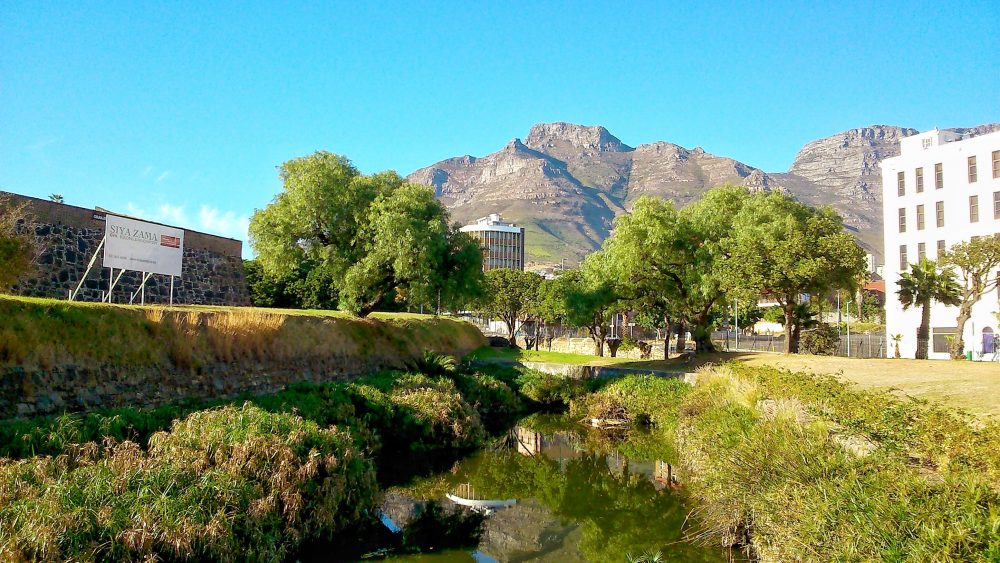
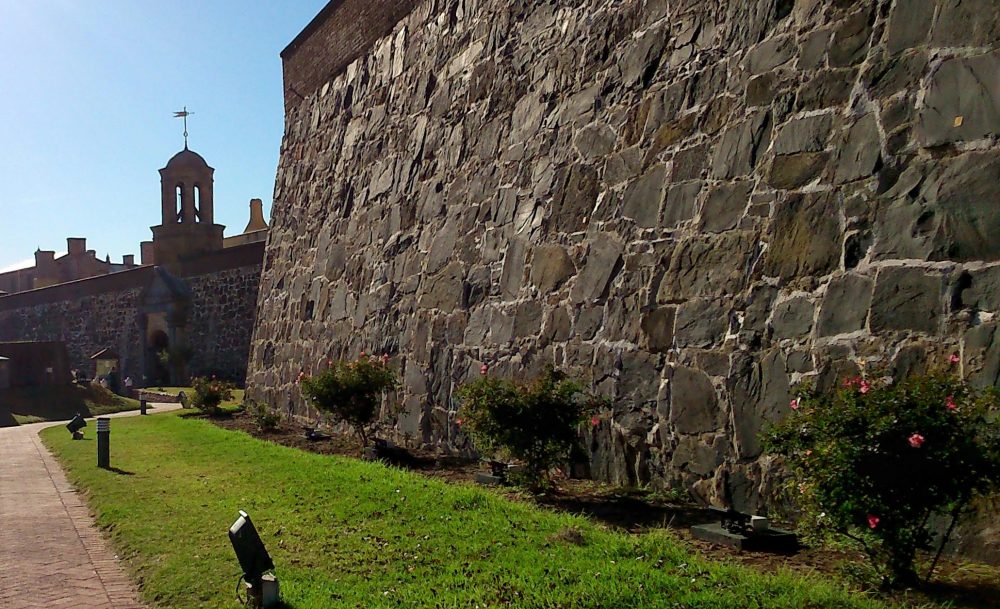
This path is flanked by well-kept lawns and neat flowerbeds and curls around the lofty Leerdam Bastion.
Within a few moments, you are greeted by the rather impressive Castle Gateway and its accompanying cutesy, lemon yellow ‘guard posts’.
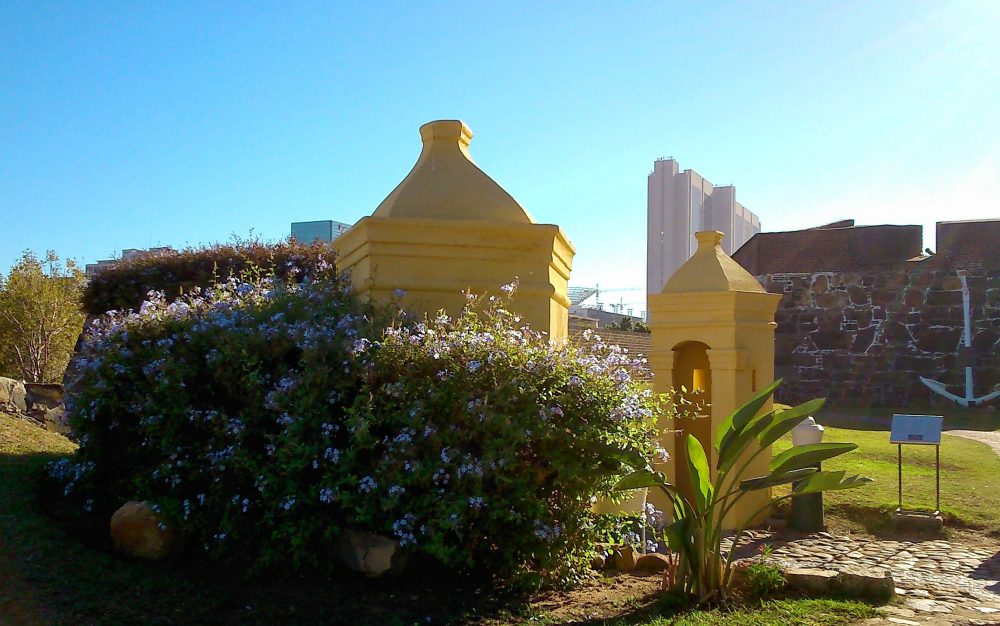
Tip: The main entrance is literally across the road from the Grand Parade.
Sacrifice Remembered
Here, near the main entrance, I checked out some of the nearby garden’s highlights. These include one of two castle crosses and the small herb garden and lemon grove.
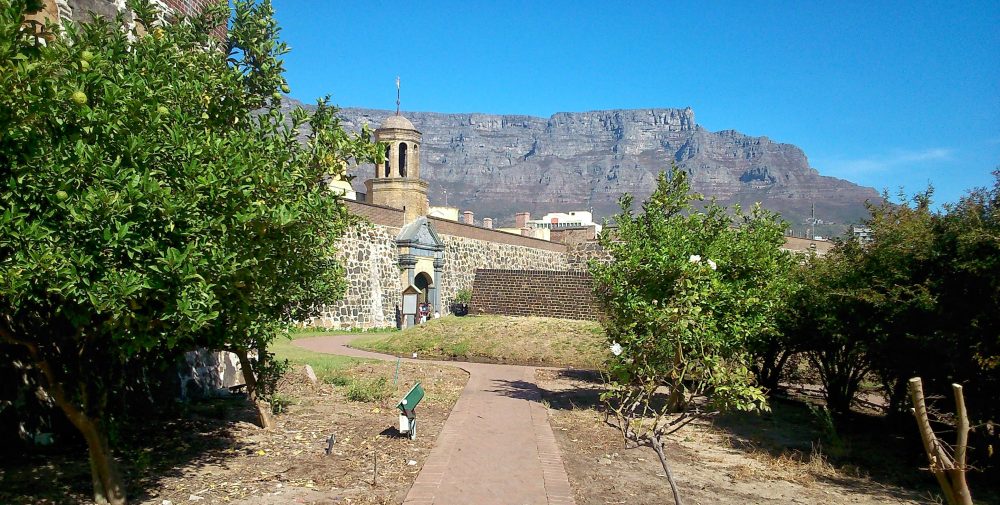
These twin crosses, made from Delville oak, are poignantly dedicated to remembering all SA soldiers who lost their lives fighting in WWI. (You can find the second cross inside the castle grounds proper.)

The Gateway and Bell Tower – which were both added between 1682-’84 by Simon van der Stel and the visiting Commissioner van Goens – are well-worth admiring.
A Change in Entrance
The original 1678, sea-facing Strand Street (in Afrikaans, ‘strand‘ means beach) entrance, known as the Waterpoort, was replaced by this newer entrance. It lies between the Leerdam and Buuren Bastions.
As my group’s excellent tour guide later explained to us, the entrance was changed because the waters used to literally lap against the castle wall and even flood the courtyard.
(Note: Today the Waterpoort entrance houses the extensive Military Museum.)
The new entrance is utterly beautiful. It even features an octagonal bell tower. The tower is made from ‘klompjes‘.

Fun Fact:
Klompjes are little yellow bricks that were used as ballast in Dutch East India Company (or Verenigde Oost-Indische Compagnie (VOC)) ships.
Dutch Influences in the Castle of Good Hope
As for the bell itself, which is rung during the Key Ceremonies, it was cast in Amsterdam in 1697 by Claude Femy. Fascinatingly enough, it still hangs from its original wooden beams.
The exquisite gateway’s triangular pediment portrays the United Netherlands’ coat of arms with, “the crowned lion rampant holding the seven arrows of the united provinces.”
Below this, one can still clearly see the arms of all the Dutch cities in which the VOC had its chambers. The cities are: Hoorn, Delft, Amsterdam, Middelburg, Rotterdam and lastly, Enkhuizen.
I found it interesting to see each of the arms and their specific symbols.
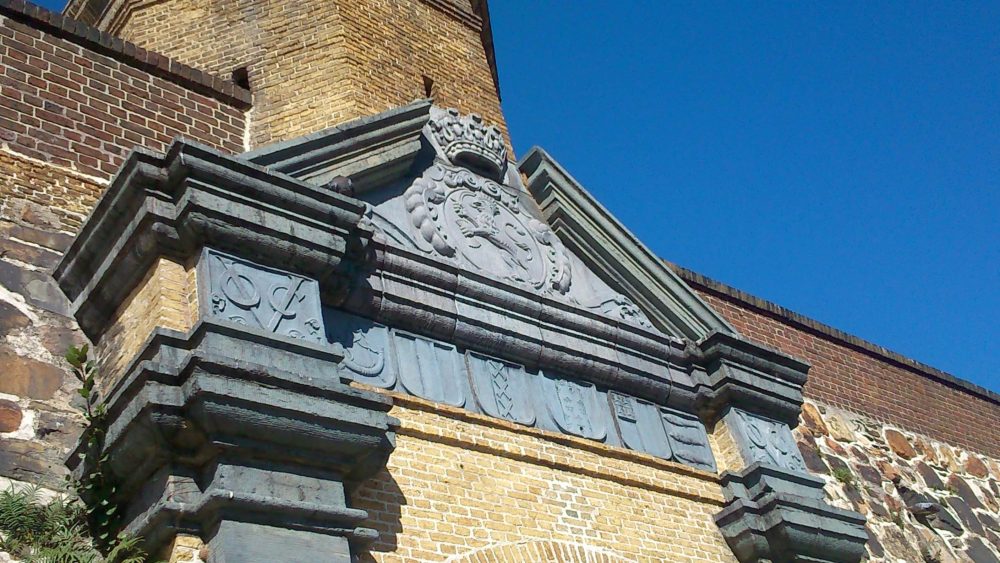
Two VOC monograms flank these. Tip: Keep your eyes open and you will see many of these scattered across the castle’s various surfaces.
The two pilasters, entablature and pediment, above are built from blue-grey coloured stone. While the entrance itself is made of tiny yellow bricks – similar to the previously mentioned klompjes. These, however, are apparently known as ‘ijselstene‘.
Together, they make it a decidedly unique Cape example of seventeenth century Dutch classicism.
Friendly Soldiers and Staff Within
The two guards on duty positively made my visit; they were really friendly and fun. They even kindly took a photo of me posing in the entranceway.

I also managed to persuade the soldiers to let me take a photo of them, posing very smartly together.
Exploring with Gateway Guides‘ Castle Guide
After that, I finally passed through the gateway and head to the Information Centre where the secretary (as the guards had already done) informed me that on Freedom Day, the Castle was free to visit.
As she ran up my admittance ticket, she handed me a smartly designed, informative Castle’s Gateway Guide. (To view the other Gateway guides, please see Gateway Guides.)
This guidebook was utterly indispensable to me. I used it to explore the Castle grounds (and all the various nooks and crannies) largely on my own before later joining the (English) Castle tour group.
It has all the necessary historical information and helpful photos/illustrations. This makes finding your way around simple and easy. Even if you feel somewhat lost and unsure of where to go next, as I did at first. (If that happens, just subtly ‘gatecrash’ one of the unofficial Castle tours.)
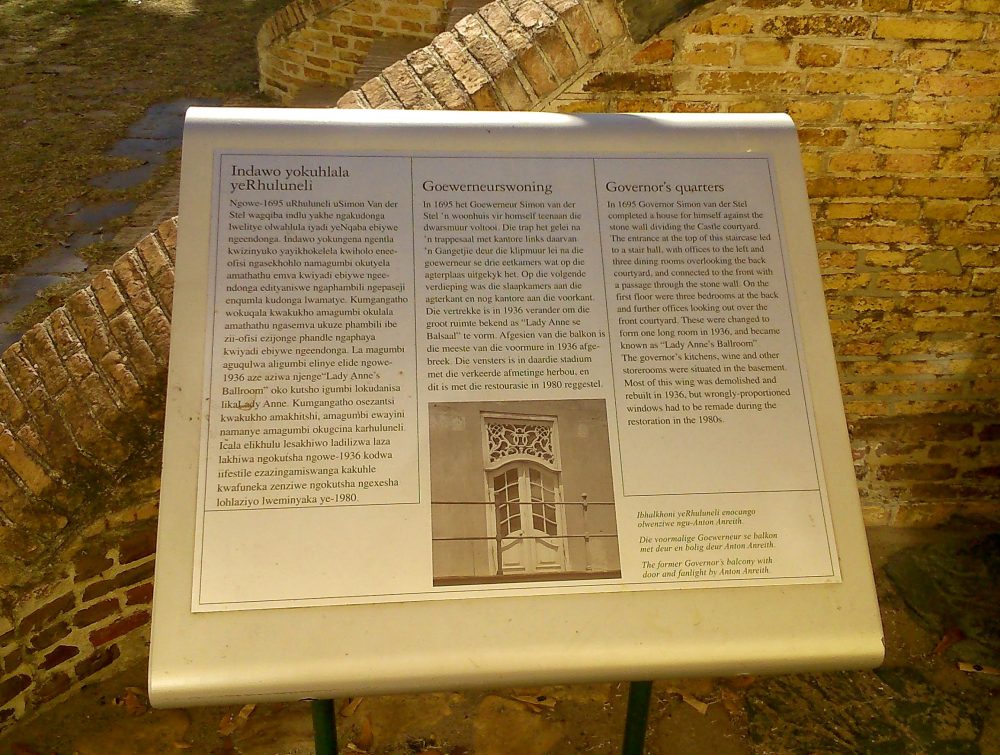
However, the Castle also features ample signage. This offers excellent drawings and informative facts about the buildings, specific areas and the like.
You can also find other pamphlets and maps in the centre, as well as an ATM.
Castle Entry Fees
Currently, at the time of updating this post (November 2021), the Castle entrance fees are:
- Adults: R50
- Pensioners: R25
- Children: R25
- Booked school groups: R8
The pricing is really reasonable. I really think it is wonderful value for money, as there’s so much to see and enjoy inside and out!
The Key Ceremony and Cannon Firing Loom
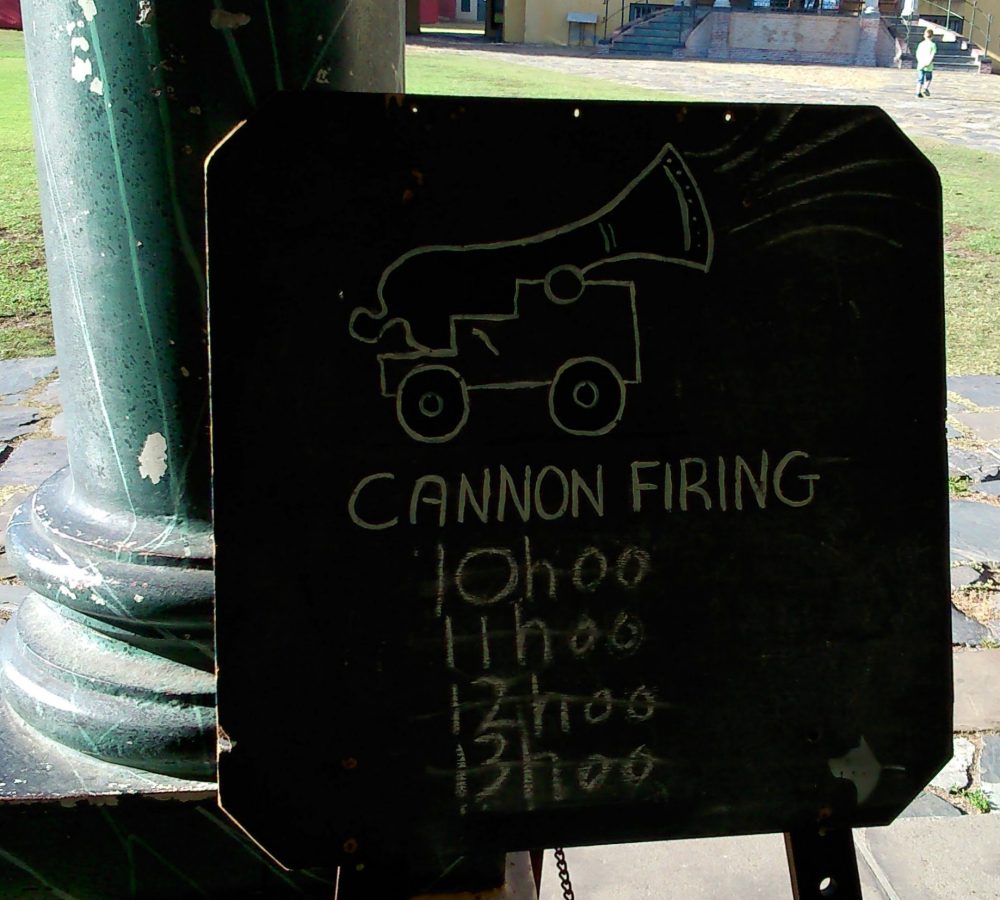
The secretary also informed me that the Key Ceremony was due to take place at 10:00 am. She advised me to hang around if I was interested in watching it.
So, along with a few others, I lingered most happily in the amazing Outer Court for a bit before the ceremony got underway and more crowds gathered.
As I had arrived at the castle relatively early, there were not too many people visiting.
Later in the day, especially around noon, however, there must have been close to a hundred, if not more, people in and around the Outer Court alone.
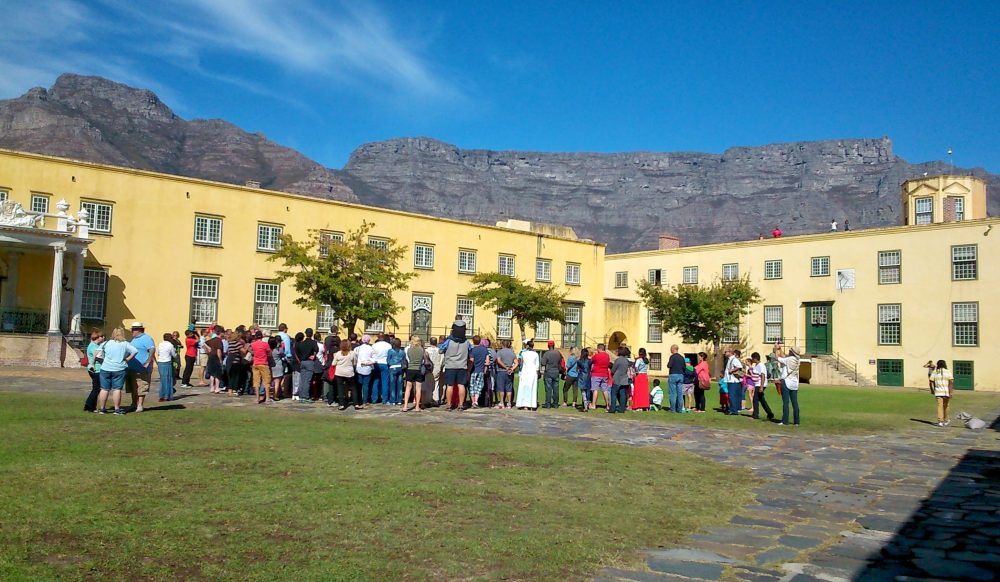
I honestly thoroughly enjoyed experiencing it with such a large crowd.
Still, it was great to explore most of its main attractions on my own before the crowds really flooded through the Castle’s gateway.
Exploring the Outer Court
When you step out of the Centre, leaving Block A’s protective pillars (originally made from wood, they were cast from iron and painted to look like marble, which they really do!) behind, you encounter the large, immaculately maintained Outer Court.
Aside from its neat lawn, it is dotted with cleverly placed benches and trees.
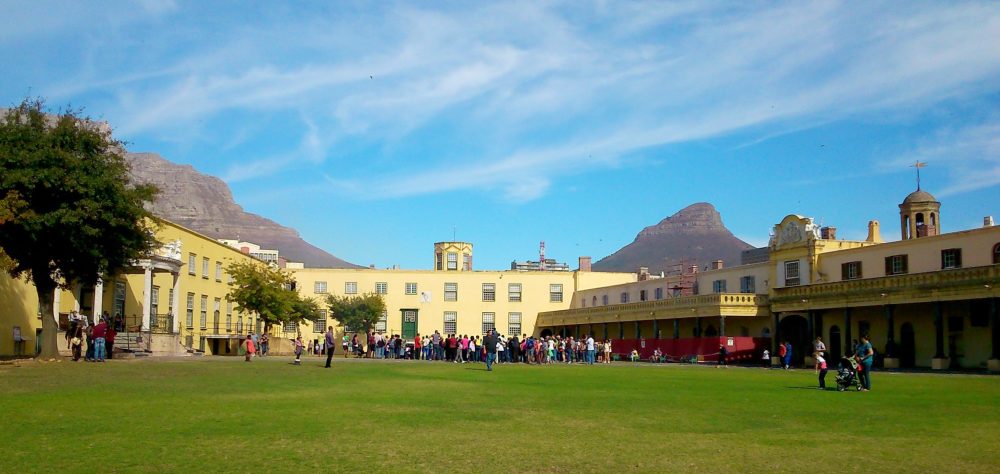
It’s hard to fully express in words just how amazing the sweeping, 360-degree view of Cape Town’s famous trio (Table Mountain, Devil’s Peak and Lion’s Head) afforded by the Outer Court truly is. But I hope my photos do it some small justice.
With a historic setting like this, it is no wonder that many international film crews – including Netflix’s The Crown – have filmed at the castle and its gateway and courts.
Trophy of Arms
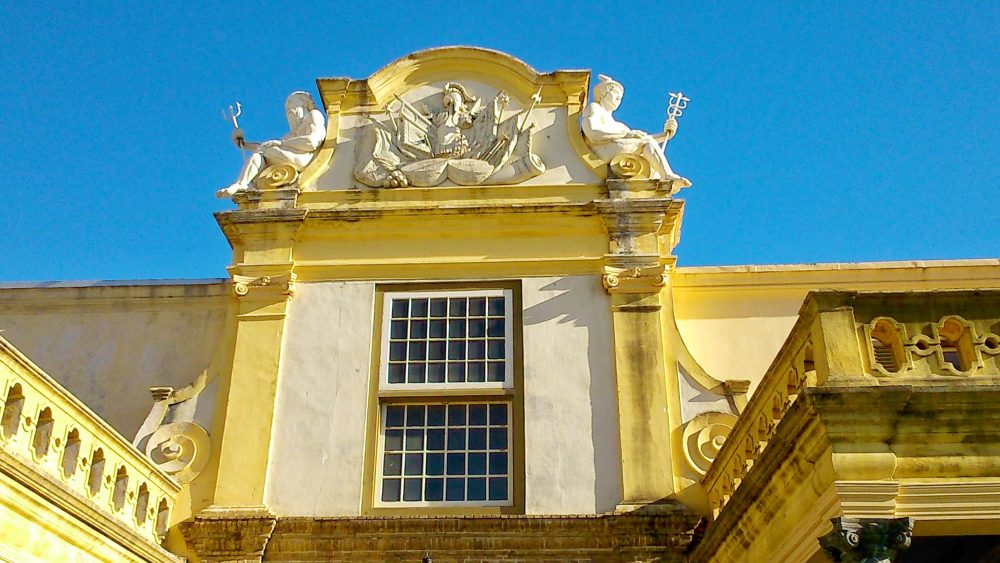
If you face the main entrance, be sure to take note of the Inner Gable with its “allegorical trophy of arms” carved in teak. It’s quite something.
Fun Fact:
The original can apparently be found in Block F’s grain cellar.
The two figures on either side of this have been “reconstructed from Lady Anne Barnard’s paintings.” As are many other things found at the castle. Even the uniforms worn by the present day guards are based off her illustrations.
A Castle Restaurant

Next, there’s the charming De Goewerneur Restaurant (now called Re5 Restaurant apparently). Before I left, I stopped by it to sample their coffee and ‘cake of the day’.
The on-site eatery offers castle visitors glorious indoor and outdoor sitdown seating. There is also a kiosk available here.
If you have the time, the castle restaurant is worth visiting.
The Castle of Good Hope’s Block F
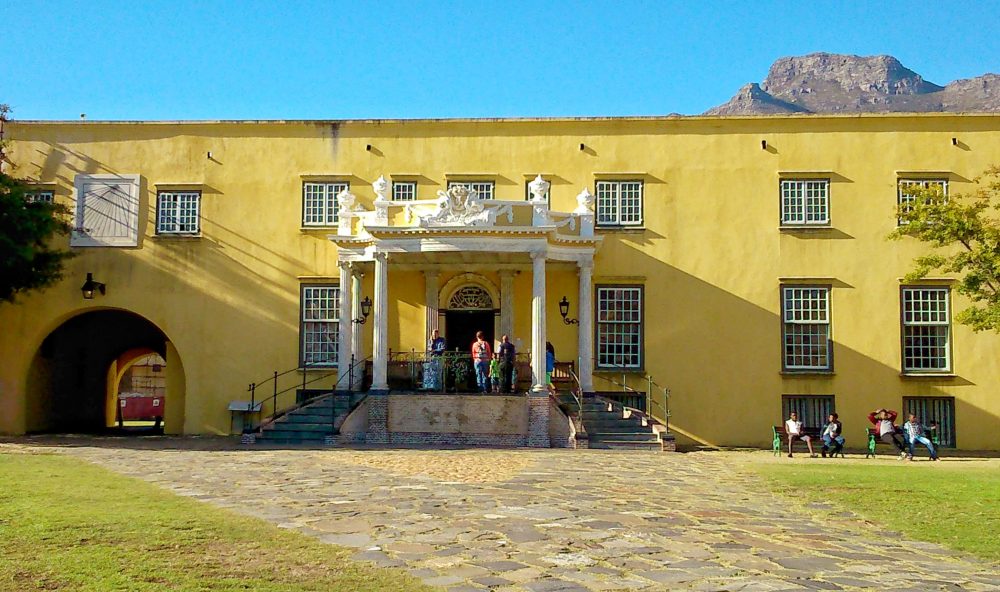
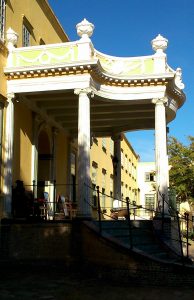
If you cross over to Block F (my personal favourite part of the whole Castle), there’s the beautiful Kat (Puije) Balcony. It is here that part of the Key Ceremony takes place.
It is also where you can view the excellent Iziko William Fehr Collection. The collection includes the most amazingly well-preserved and breathtaking antiquated furniture, paintings and ceramics from the 18th to 19th century.
Fun Fact:
All important proclamations were made from this balcony.
Also, though the balcony was originally created in 1695, it was changed in 1786 to the lovely Baroque version we see today.

It is also home to the Lady Anne Barnard Banqueting Hall.
In the past, the Governor’s quarters also used to be situated here.
Inner Archway and Inner Court Highlights
Just alongside it, you find the Inner Archway, which leads into the Inner Court.
Highlights herein include: the Castle Well and the aforementioned second WWI Memorial cross.

Directly above the Archway, meanwhile, is the rather large Vertical Sundial; I will elaborate on this in Part 2 of my post series.
Fun Fact:
It was used for official afternoon time. The one across at Block B, meanwhile, was used for morning timekeeping.
Restorative Renovations at the Time of My Visit
At this point, I feel it’s important to mention that, at the time of my visit, the Castle was receiving some restorative TLC.
It was “undergoing extensive renovations” at the hands of Siya Zama GVK Building & Renovation.

As a result of this, certain parts of the Castle were closed to the public on the day.
When I visited, this included the following sections:
- the Secunde’s House (essentially, this used to be where the Deputy Governor, or second in charge, would reside)
- the Granary
- the Cape of Good Hope Gallery
- the Dolphin Pool
In time, I would like to revisit the castle and see all the places I could not visit on the day!
After that, I went in search of the castle bathrooms. They are located just past the Governor’s Quarters, near the so-called thoroughfare that leads to the Dolphin Pool and Inner Court.
Note: There is signage directing you to the cellar where they are situated.
The Key Ceremony Begins
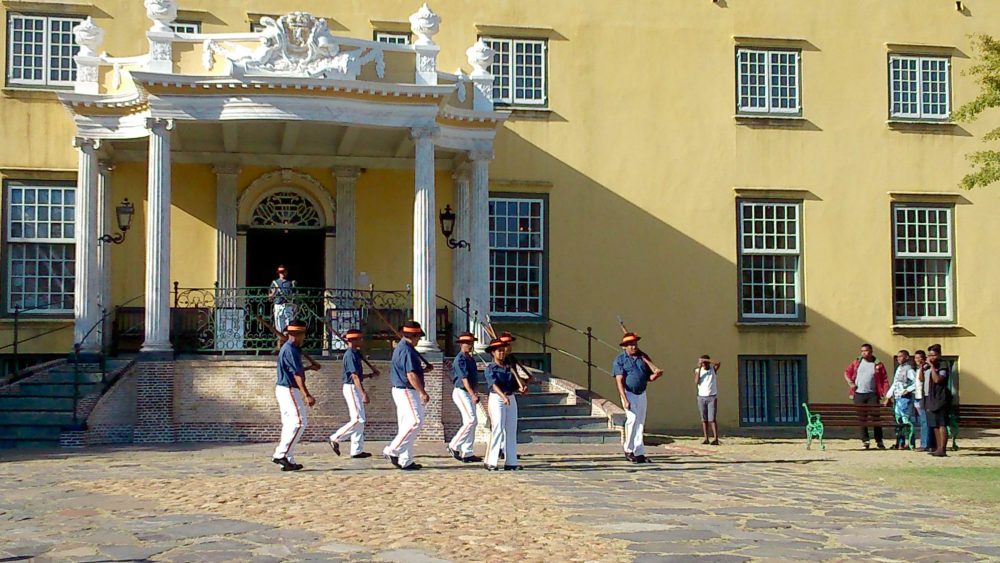
After that, at 10:00 am sharp, the Key Ceremony commenced.
At first, everyone gathered around the small bronze cannon just off from the Outer Court’s main pathway, in quiet anticipation of the firing of the Signal Cannon.
Before the man in charge of the cannons (a member of the Cannon Association) explained to us that the cannon would only be fired after the Key Ceremony.

Performed Monday – Friday, The Key Ceremony – a modern re-enactment of the original ceremony – was pretty fun. However, on the day, the female announcer unfortunately made it sound quite dull.
Note: Castle ceremonies are weather-dependent and the Cannon Firing does not take place on Sundays.
Still, I quite enjoyed watching the handing over of the key and the marching of guards as they went to the main gate to ring the bell. (At noon, it tolls 12 times).
Read More in Part 2
If you’re interested in more on my Freedom Day experience and the Cape Town Castle, please check out Part 2 here. 🙂

Sources Cited
Many thanks to the Castle of Good Hope website and Gateway Guide’s The Castle of Good Hope guide for the additional information and factual insights in this post.
Post Disclaimer:
At the time of publication in 2015, this post was up-to-date.
However, as at November 2021, I have done my best to update pricing and other visitor information.
About the Author


