

On March 4th, I finally ticked yet another Cape Town adventure off my local travel wishlist. It is something I have been wanting to do for almost two years now… so I will provide a little background story behind my quest to visit the Signal Hill Noon Day Cannon.
It all started in January 2014 when, driving around the CBD with my parents, we heard what sounded like a mini-explosion go off in the city in the midst of a hot, summer haze of frenetic traffic.
I joked and said it must be something exploding beneath us, as the sound reverberated right around the traffic crossing. But the road did not give way to swallow us whole so we drove on. I didn’t really think about it again… At least, not for a short time at any rate.
The Lunchtime Boom
Then, once I was resident in the city a month or so later, suddenly an ominous boom echoed around the city.
I literally jumped in momentary surprise as I walked the city streets with my friend, a born-and-bred Capetonian. They laughed when I asked what on earth had just happened, glancing around me and expecting to see a building or car exploding Die Hard-style.
No, once again… nothing of the sort. But there was no doubting it: this city seemed to have an alarming number of things going ‘boom’ in the daytime hours.
“What, that? That’s just the noon day gun… it goes off every day.” They explained nonchalantly in reply, not batting an eyelid at the sound.
Right, a city with a terrible blast going off every day. That sounds right up my alley… Well, actually, it is – and the cannon’s noonday blast fast became my favourite way to gauge the time of day.
“Ah, it must be 12:00 o’clock.” I would think to myself, with a wry smile, as the blast would sound day in, day out.
Sometimes softer and barely noticeable over the sounds of the city. Other days as loud and resounding as if I were merely thirty metres away from it.
Hello, My Old Friend
It didn’t always go off at 12:00 p.m. on the dot each day but it was pretty consistent all the same. I soon grew to love it because it was yet another singularly characteristic feature of my city.
It wasn’t long before I, too, would occasionally snigger (along with the locals) at poor, unsuspecting visitors to the Mother City, as they would look up at the skies with mild consternation, no doubt thinking, as I once had: “What the hell was that?”
It turns out there is more behind this old cannon than just a daily lunchtime reminder.
And, because I’ve always had an insatiable curiosity and a certain fascination for history and travel, once I discovered you could visit the cannon for yourself, I wanted to be one of the many people to do precisely that.
I have tried to persuade a few friends to accompany me over the past two years but, needless to say, the prospect of trekking across town to see an old cannon is not everyone’s idea of ‘fun.’ 🙂
So last week, on one of my limited free days, I decided to make the trek on my own. I picked a sunny day* and made my way across town, having already ‘googled’ directions and done some historical research in advance.
Every TripAdvisor review I read online heaped praise on the old cannon’s faithful firing and advised one to get there before or around 11:35 p.m. The reason for this is to be there in time for a brief historical account and detailed explanation before the blast.
* (Word of warning: Don’t be foolishly stubborn like I was and leave your sun cream behind if you visit on a hot day.)
I had the correct directions and a map of the city in hand but, because I wanted to try approach Military Road (at the end of which, I assumed the cannon rested) from Bo-Kaap, I ended up taking a detour and feeling pressed for time as the minutes ticked by and I was no closer to my final destination.
Navigating Bo-Kaap and Surrounds
Bo-Kaap is a suburb with a lot of Cape charm and history. The houses are famous for their bright colours and when you walk up the steep (in some places, really steep), cobbled roads in between said houses, it’s quite a sight to behold.
I love the cheerfulness and quaint charm they possess so I wanted to take a tour of the area en route to my destination.

Somewhere past the pale yellow Bo-Kaap Museum, I found my side-street navigational skills sorely wanting.
The area was quiet, with only a few tourists (taking photos of the beautifully painted homes nearest the Museum) and locals in the street.

I approached a lady and asked her if she could direct me to the cannon. She told me to keep going straight up but then beckoned me over to a house where, from the kitchen, a man kindly directed me.
He advised that I head back into Buitengracht Street (which, as I had just come from there, made me groan inwardly) and said I would find my way best from there. I gratefully thanked them and headed back down into Buitengracht.
From there, I knew my way well and soon found myself heading along the original intended route I had looked up earlier in the day.
Heading through the edge of Tamboerskloof, an area just above from the Protea Fire and Ice Hotel, I followed carefully spaced signage that clearly indicated ‘Noon Gun’ and made for easy navigating.


Along the way and, as you head up the gravel road, lined by a combination of thorn- and gum-trees, you are rewarded with some stunning views of Table Mountain and the city it so boldly presides over.
City Vistas
I stopped several times along the route to take photos, despite running short on time – at least if I hoped to make the pre-firing introduction, that is.
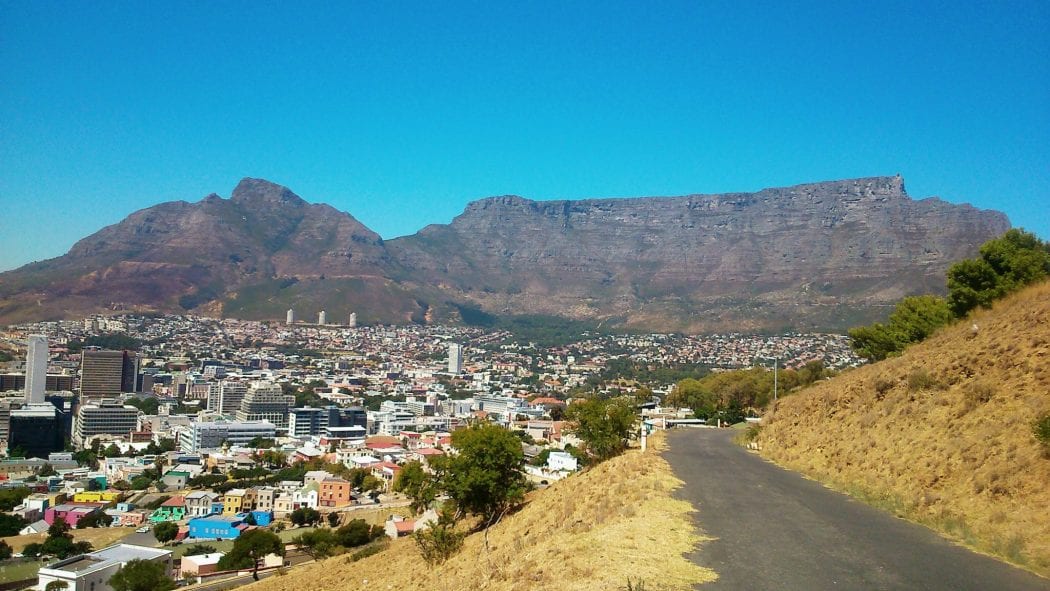
The road and verge is well-maintained so you really don’t have to worry about wrecking your tyres to make the journey up.
After Vista High School (certainly well-named as they, along with Jan van Riebeek Hoerskool, must have the best city vista of all the schools), you are relatively close to the cannon’s hilly vantage point.
The Lion Battery: Home to the Noonday Guns
The Lion Battery, owned by the SA Navy, was built between 1889-1890. Originally, it was armed with two nine-inch rifled muzzled loading guns.
Though, when it was remodelled in 1911, it was rearmed with two 9.2-inch MK X breech guns instead. These could fire a 170kg shell to a maximum range of 28km.
However, the firing of these guns ceased in 1935 due to the blast damage being caused in Green Point below.


This treed-up, fenced off military area just below main Signal Hill – so named after its original use as a vicinity for signal flags, used to communicate with approaching ships, and later, for the noonday gun firing that would occur here – is, to all intents and purposes, something of a cannon resting place.
Where Cannons Go to Retire
There must be about twelve, including the main two, scattered about the area, beneath the gum and pine trees or mounted on cement emplacements.
They still protectively keep a weathered eye on the city today, much as they would have done hundreds of years ago.


They are found in all shapes and sizes; I was delighted to check out a few of them.
My favourite remains the large, faded silver one pictured below. It differs from its cast-iron counterparts and, although it has suffered more from the elements as a result, it is wonderful to see.
Four of the guns, which you can see in the distance in the accompanying photo, are the 12-pounders. They are used on state occasions like the recent State of the Nation Address.


Some areas (like where the 12-pound cannons are found) are naturally out of bounds. But you can explore the area, as we did that day.
I didn’t even dare to touch any of the old, hallowed cannons but I thoroughly enjoyed photographing them all the same.


Exploring the Lion Battery
After that, I went back to the main cannons. There are indeed two, above the smaller, unpainted one situated in the midst of the Lion Battery’s white-and-green walled cement structure, with its accompanying plaque. (Unveiled by His Excellency, Mr Tristan D’Albis, French Ambassador to South Africa, on March 25th 1999).


According to the plaque, this particular cannon was cast at the Arsenal of Nantes and was placed in the Woodstock Battery in 1782.
The plaque tells us: “At the request of the Dutch government, French forces contributed to the defence of the Cape Colony between 1781 and 1787.”

I hurriedly ascended the cement steps and peered over the green fencing at the two matching, bottle green cast-iron cannons.
They looked immaculate, as did their mounts.


Then, with wide-eyed wonder, I walked about the dry, grassy expanse along with the others visitors (later totalling at least twenty).
We were all helplessly admiring the breathtaking scenes of the city below us, especially Green Point, the Harbour and the lovely Cape Town Stadium – which I am personally very fond of – and of course, Table Bay. As I did so, I could not help feel more than a little blessed and proud.
For the views alone, this was certainly a most worthy journey.


The grass is short and dry but be warned: three-pronged thorns (known as ‘dubbeltjies‘ where I hail from) plague it in full force.
Within moments, I had carelessly stepped on several bushes and accumulated, oh, about twenty thorns in each of my flip-flops. I spent at least five minutes trying to extract them from my soles but eventually gave up and gingerly walked about, admitting defeat.
For this reason only, I advise wearing closed-in shoes or at least sturdier sandals and be sure to watch where you place your feet.
With all this and the dry, fynbos-strewn hills around me, I felt more at ease than I usually do in the city.
Every so often, I find myself in a place that reminds me so keenly of the countryside where I grew up that I instantly revert back to the relaxed, careless farm girl.
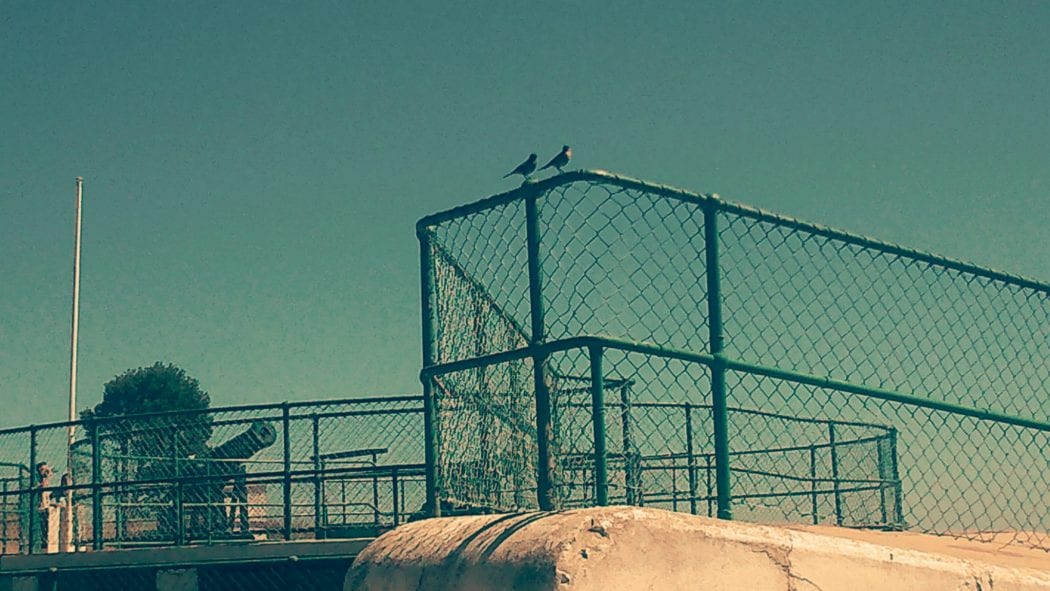
Adding to this feeling were the adorable, little Familiar Chat birds that were squawking at me indignantly as I explored their territory.
Again, these are virtually pets back home and I was amused to see them perched boldly on top or just in inside the cannons’ muzzles.

Waiting for the Firing
I spent some time just strolling around the vicinity, admiring the scenery and taking photos from all angles, as gradually the crowds increased as tour buses rolled up the drive.
Many of the tour bus operators are well-versed in the routine. I listened to them telling their passengers where it was best to stand and watch the cannon firing from.
It was interesting hearing them give a brief run-down of the local history behind these rather magnificent military pieces.


Around 11:45 p.m., the officer who fires the gun appeared, decked out smartly in a military hat and white uniform. With him, he carried the vital cannon firing equipment: the gunpowder bags and detonator.


After that, he raised a maroon flag (no doubt like those once raised in signal) and called us closer for our pre-firing welcome and introduction.
We stood just behind the cannons and listened as he introduced himself as Alistair. He then began to relay the history behind the twin-like cannons to us. (If I am not mistaken, the cannons are the same apart from their carriage.)


 Alistair did a sterling job and was a really nice, professional person to interact with at the cannon firing. He kindly welcomed us to ask him questions before or after the firing.
Although I recorded everything he said and tried to take mental and literal notes of the key information, sadly, due to the wind, my audio was almost inaudible. So I will combine what I jotted down with some sourced information.
As he explained, there are two guns (or cannons) used in the Noonday Gun firing. Each day, one of them is fired on an alternating basis. They are the sea-facing cannon and the mountain-facing cannon respectively.
Sea-facing and Mountain-facing Cannons
For the day’s firing, he would be using the sea-facing one, as he had fired the other one the previous day.
However, he loaded the mountain-facing one just in case the other did not go off.
These two cannons, which are some 222 years old now, are not only Cape Town’s oldest surviving tradition. They are also the two SBML oldest cannons still in daily use in the entire world… Not bad, Cape Town, not bad at all. 🙂
They are believed to have been used in the famous Battle of Muizenberg, fought in 1795 between the British and the Dutch.
They were apparently left behind by the British in 1803 and later transported to the Imhoff Battery near the Castle of Good Hope (you can read my review of it here).
They were used from February 1st (I couldn’t help but smile at the fact that my birthday bears some historical significance) of 1806. Originally, they were fired at sunset, then at 13:00 p.m., before finally settling on the now-traditional noonday firing time.
On August 4th, 1902, they were transported by ox-wagon to their new and current position at Signal Hill after residents complained and requested that they be relocated. (This is no wonder, given the sound they make…)
Since 1902, these ’18-pounder smooth bore muzzle loading guns’ have been fired (interchangeably) 65,837 times (as seen on March 4th).
As Alistair told us, you can see the ‘firing number’ displayed below, as well as the day’s date, on the SA Navy board.

Alistair then told us how they were prepared for use in World War II (however, they were never required). He also elaborated further on their history.
In the past, they would have been loaded with 3kgs’ worth of gunpowder. But today, as a safety precaution, they are loaded with a 1.5kg bag. The bag is made of a special protective material, which, when the cannon is fired, burns up completely along with the gunpowder.
Hurry Up and Wait
Alistair also showed us the small, brassy detonator that fires the cannon. It is placed inside the firing mechanism, as far as I understand.
After he had checked the cannons and cleared the bores (the interior of the gun barrels) with the special rod – all we had to do was wait for the clock to strike twelve.
As we still had some moments to spare, he allowed us to ask questions.

Then we were asked to move back, either up to the trees to or to the side of the cannons on the furthest edge of the grassy patch overlooking Green Point and surrounds below.
This is a necessary safety precaution. It is compulsory for everyone to be well-clear of the firing line before the cannon goes off.
Standing some thirty metres away, beneath the shady trees, Alistair gave us at least a thirty second countdown to the firing. (If this cannon failed to go off, he would have to fire the other one.)

I recorded the firing and I can tell you, even though the cannon unfortunately misfired on the day, it still made a suitably loud bang and left a lot of smoke behind in its wake.
The misfiring can sometimes happen (usually because of the gunpowder being slightly damp apparently). But I doubt anyone in the city notices – in fact, none of us present noticed the difference until Alistair told us.
You are also, naturally, advised to cover your ears before the firing. I covered one ear with my hand and hoped I wouldn’t be deafened in the other as a result of my recording. Still, it was a risk worth taking and I feel the blast was not as loud as it should have been, had the cannon fired perfectly.

Memorable Military Excursion
After that, I went back to the emplacement with the others and Alistair showed us the now-partially blackened detonator.
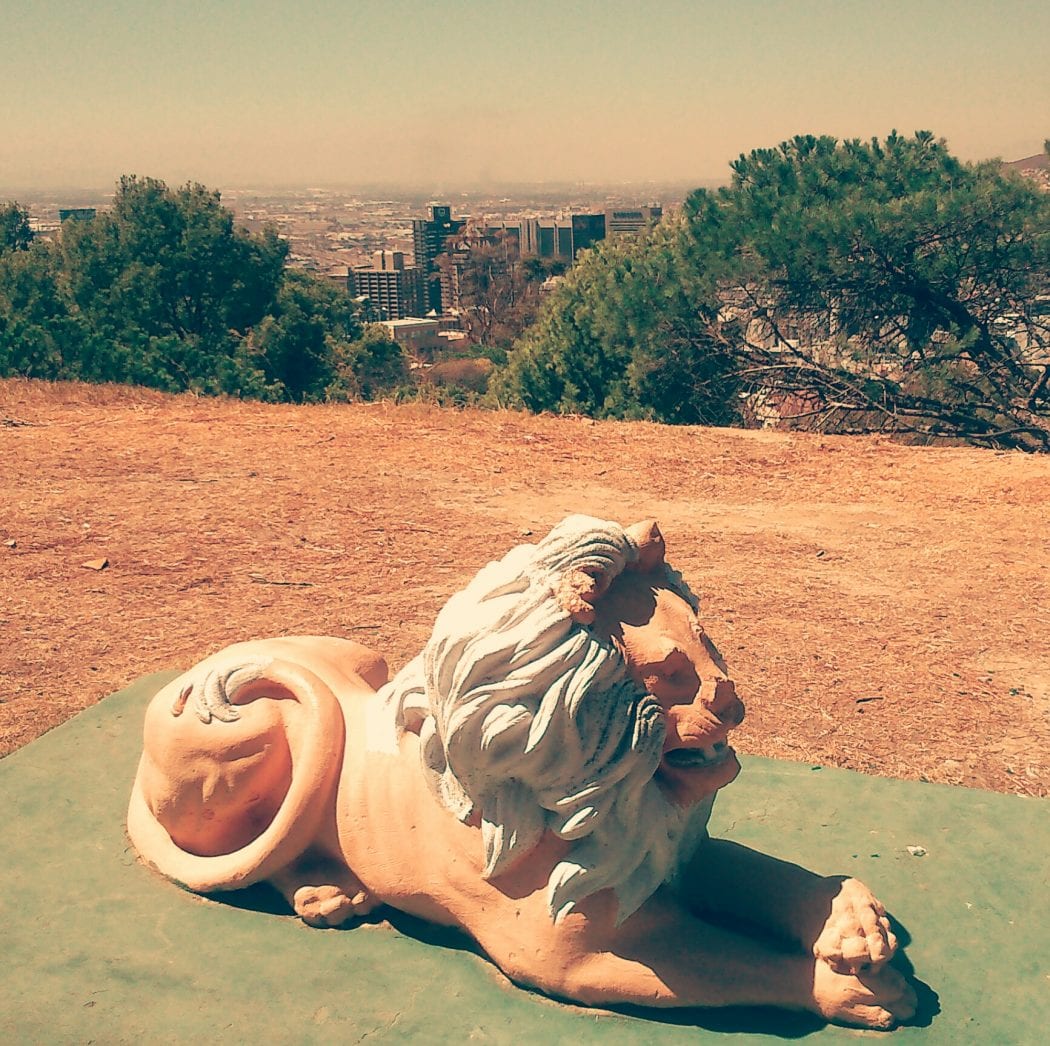
After thanking him and bidding the Lion Battery farewell (look out for the white-and-peach coloured lion statue that guards its entrance), I made my way back to the city.
The experience was definitely worthwhile and I really enjoyed my little ‘military excursion’.

If you are interested in seeing the cannon(s) for yourself or learning more about its history, you can visit it daily (except on Sundays and public holidays) for the firing at the Lion Battery, Military Road, Bo-Kaap, Cape Town.
For closing and opening times of the Battery, please contact authorities or ask when you visit.
Thank you to the following sites: http://www.capetown.travel, http://www.sa-venues.com, http://www.capetownmagazine.com, http://www.safarinow.com, http://www.tripadvisor.co.za and http://bokaap.co.za/noon-gun for the additional information used in this post. I also wish to thank the SA Navy and Noonday Gun personnel (especially Alistair) for the continuation of this wonderful daily tradition and unique Cape Town experience. 🙂
Additional History Trivia
Below are some historical facts related to the Noonday Gun(s):
- Designed by Captain Thomas Blomefield in 1786 and cast in 1794 by Walker and Co., the noonday gun(s) were proof-fired in June 1794 in Woolwich.
- Noonday firing was meant to aid sailors in ascertaining the time while out at sea. (Either through the sound of the cannon’s boom or the smoke that followed.)
- The two minutes’ silence tradition, observed globally, is believed to have been started by South African ‘Jock of the Bushveld’ author, Sir Percy FitzPatrick after his son, Nugent – a Major in the Union Defence Force (UDF) – died in battle in France. This tradition, which went hand-in-hand with the noonday gun firing, was brought to Cape Town by Sir Harry Hands, Mayor of Cape Town, on May 14th, 1918. The first minute is to give thanks for survivors, while the second is borne out of memory and respect for the fallen.
- Capetonians once used to rely on the gun’s firing for the precise time of day.
- Originally, Signal Hill, where the Lion Battery is perched, would notify the public if a ship was in trouble. Signal flags were also used to provide weather warnings.
About the Author




This is so cool – I’ve been to Cape Town a number of times but have never checked out the firing of the cannon – it’s now on my list for next time I’m there!
Thanks so much, Elle! 🙂 Glad you could learn something new through this post. It is really worthwhile, I hope you will be able to go sometime. 🙂