
Freedom Day Visit to the Castle of Good Hope: In Closing
A few years ago, I was fortunate enough to visit Cape Town’s own castle, the Castle of Good Hope. In my three-part post series, I reflect on my Freedom Day visit. To read Part 1 of my visit, please see here – and Part 2 here.
Just after 11:00 am, our English tour group gathered around our great, rather humourous tour guide at the entrance to the Inner Archway.
He started asking random people where we were from. (I would hazard a guess that there were around 40-45 of us on the English tour, including a few tourists.) I was one of the people chosen as I was standing close by.
He began our tour with a condensed, easy-to-understand historical account of the Castle and some of its important figures. My account might not be as amusing and enjoyable. Still, I hope it paints a fair picture of the Castle’s colourful past.
Reflecting on the Castle of Good Hope’s Rich Cape Town History
As it was built in 1666 and 1679 by the Dutch East India Company (in Dutch, it is the: Verenigde Oost-Indische Compagnie or VOC), the Castle of Good Hope “is the oldest surviving colonial building in South Africa”. Up until 100 years ago, it was also the tallest building in Cape Town.

Upon Leendert Janzen’s advice, it was agreed that Jan van Riebeek be sent to establish a “formal refreshment station at the Cape”. So, when van Riebeek landed in Table Bay on 6 April 1652, one of his first tasks was to build a fort. This was intended to aid the Dutch East India Company on their trade voyages to and from the East.
Two days after his arrival, van Riebeek began working on the Fort de Goede Hoop. This was situated near the shoreline, where the present-day Grand Parade lies. (Yes, the ocean has receded that far back.)
Damaged by the Cape Elements
Although the fort faced no attack from local or foreign enemies for several years – the Cape’s harsh winter climate eventually started to erode it. This was because the original fort’s outer walls, like so many other old Cape buildings, were built from clay, sods (or turf) and brushwood. (The interior was constructed from timber and brick.)
However, it was only when war broke out in 1664 between England and the Netherlands that Zacharias Wagenaer – van Riebeek’s Cape successor – was sent to build “a bigger and more comprehensive defence structure.”
Cape Town: Tavern of the Seas
The Company’s Gardens, another of my favourite spots in the CBD, was also planted around this time. It was designed to provide the necessary victuals (or fresh produce) for sailors travelling to and from this point. (In fact, back then, sailors referred to Cape Town as the ‘Tavern of the Seas’.)
Especially as they would spend months abroad sailing vessels so they ran the risk of contracting diseases like scurvy.
More on The Castle of Good Hope’s Design
The Castle’s original design seems to be attributed to renowned French fortress engineer, Sebastian Vauban. While Dutch artillerist and military engineer, Menno, Baron van Coehoorn is “associated with the final design”.

The Castle was designed in the shape of a pentagon with a bastion, which, at each corner, contained its own gunpowder magazine.
Each of the five bastions* were named after one of the Prince of Orange’s official titles. These are as follows: Leerdam, Oranje, Buuren, Catzellenbogen and Nassau.
*(Fun fact: The average distance from one bastion to the next was 180 metres. The average height of the curtain wall was 10 metres.)
New Location for a New Castle
Today, the Castle stands roughly 230 metres south-east of the original fort. This new location ensured that it was “close to fresh water and anchorage and within firing range of the town”.
Interestingly enough, the Castle is proud to boast that: “Over the centuries, six different flags have flown over the Castle. Yet, in all that time, not a single shot has ever been fired in anger at it or from it”. This fact further endeared the Castle to me. 🙂
Built Using Local Cape Materials
I also like the fact that apparently many of the Castle’s materials were sourced locally.
These building materials include the following:
- wood brought in from Hout Bay (‘hout’ means wood in Afrikaans);
- stone “cut out of Signal Hill in large blocks, which was then broken up and transported by cart to the Castle”;
- the blue slate (used for the walls) and shells obtained from Robben Island. (These were used for the mortar, which was one part shell lime, one part clay.)
It Takes a City to Build a Castle
As there was such a pressing need to see the Castle completed, the set workforce that started out as off-duty soldiers and some slaves and Khoi-na, soon grew to include free ‘burghers‘ (essentially, citizens).
Eventually, a proclamation was made that anyone – man or woman, irrespective of rank – who passed by the Castle, was required to assist with carting bucketfuls of soil to excavate the moat.
It is estimated that, at any given time, 200 to 300 people would have been working on it.
Foundation Stone is Laid
On January 2nd, 1666, Commander Wagenaer laid the foundation stone in Leerdam Bastion: the first bastion to be completed.
In 1678, the Waterpoort entrance (now home to the Military Museum, which I visited after my tour) was constructed on the Castle’s sea-facing side. However, winter swells would effectively flood the Courtyard, thus crippling the main entrance. So, between 1682-1684, the stunning Gateway – and accompanying ravelin* – that we find today became its permanent replacement.
*(The ravelin was constructed “as an outer entrance in front of the new gate. The design of this ravelin forces the road into the Castle at a right angle. The approach to the main gate meant that an attacking force could not shoot directly at the gate.)

Social Centres and Sundials
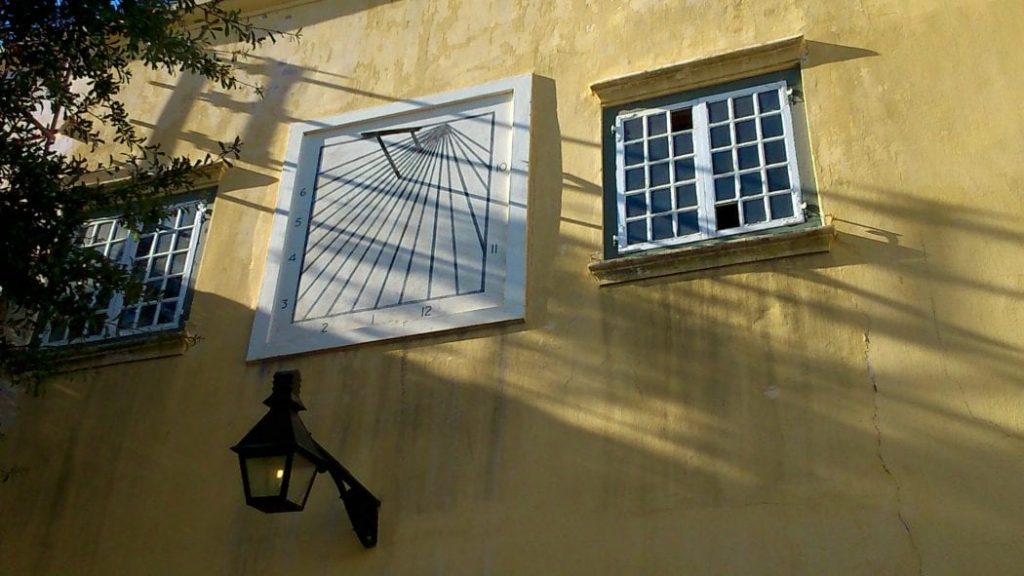
After a somewhat more concise, light-hearted historical account, our guide also explained to us about the Outer Court (the right side of Block F used to be the Castle’s social centre) and showed us the sundials.
The sundial above the Inner Archway entrance was for telling afternoon time. Whereas the vertical one across at Block B was used for morning time.
They are no longer the same as Cape Town’s current time. (I might be wrong but, if I remember correctly, they are only roughly an hour or so behind real time.)
This is because they run on the origin, separate Cape Town time. (And yes, the Mother City was cool enough to even have her own time. 🙂 )
Moving to the Inner Archway
After that, we moved into the Inner Archway itself. Apparently, the partially wooden (teak) floors still visible today were meant to soften the sound of the horses’ hooves. This is because they would pass close to the still-slumbering Governor’s quarters and the Governor didn’t want to be woken by the noise in the early morning(s). It seems almost ridiculously excessive but this sense of entitlement doesn’t surprise me much.

On a graver note, the inner Delville Cross (encased in protective glass), and nearby navy-blue plaque, serve as a WWI memorial/tribute. They honour all the South African men who fought and died in the so-called ‘Great War’.
Every year, their relatives come to lay wreaths beneath this tragically lovely Cross.
Green and Red Shutters
As we waited for the Afrikaans group to finish viewing the Dolphin Pool, our guide pointed out that the shutters and doors behind us were red while the ones in front of and to either side of the Inner Court were green. (I had noticed this earlier but didn’t know if it signified anything.)
As is so often the case in life, red signifies danger, as this is where the explosives were stored. The green ones were generally used for the soldiers’ sleeping quarters or for storage.
The Dolphin Pool
After that, we crossed over to the Dolphin Pool. The original 1690 pool was built by Simon van der Stel. It was purely for the use of his family. In 1705, it was enlarged by his son, Willem Adriaan. (He also built the nearby Bakhuys, thus making this section secluded.)
However, during the British Occupation, the pool was entirely filled in. It was only properly restored in 1987 and even when I visited, it was still undergoing extensive restoration.
However, one can still find the original steps that lead down into the pool. These were built solely for the ladies’ convenience, as they used to bathe in ankle-length dresses.
(Fun fact: The balcony facing the pool is where Lady Anne Barnard used to sit and sketch.)
Entering the Torture Chamber as Eskom Strikes
After that, we filed into the Torture Chamber and, as luck would have it, Eskom struck just as we entered the Castle’s darkest rooms.
As I didn’t want to even lean back against the walls, I pressed close to the young couple next to me. I was not the only one getting the creeps. Because the lady looked at us and said, “Actually, I think I am going back out.” When asked why, she simply said, “I just can’t deal with this,” before hurriedly exiting, as the last few people entered.
It was a tight squeeze (our guide was virtually standing on the senior clerk’s desk) but we all managed to fit eventually.

Recounting Past Horrors
Our guide very respectfully and tactfully began by asking the parents, with young children, whether he could give detail about the various torture methods. No one seemed to have any complaints.
Although he assured us he wouldn’t be too graphic, if you are someone like me with a very vivid imagination, hearing this is enough to make your insides churn. Especially if you are standing in the very room where it happened.
Before I begin, I want to make it clear that these methods were employed by both the Dutch and the British. So, back then, one was certainly no better than the other.
I took notes on my smartphone during the tour. If you prefer not to read the Torture section – feel free to skip on. But I feel it is important to note the barbaric past, as much as the good.
The most common reasons for confession by torture run as follows:
- slaves who refused to work;
- those who practised a faith/religion other than Christianity;
- those who committed (mainly petty) crimes;
- anyone who conspired against or tried to sabotage the governor.
Irrespective of the so-called crime, a confession was required before any ‘proper’ punishment could be dished out. So, think of this as the warm-up to that.
(Even petty crimes meant having something like a thumbscrew used on you. Until you either confessed to your crime or were released.)
Torture in the Chamber
The levels of torture varied but escape – or attempted escape – meant direct execution, while petty crimes meant ‘soft torture’.
Cat-o’-Nine Tails
Refusal to work; practising a different religion; piracy; and sabotage meant the slaves would have their hands bound before they would be stripped and whipped anywhere between 40-200 times with a cat-o’-nine-tails*. This device had metal hooks that would rend the flesh off the body.
*(Let that sink in for a moment. If you don’t know what a cat-o’-nine is, read up on it.)
Using the Castle Horses for Brutality
Another method of torture required the Castle horses to pull from the outside while the slave was fixed in place. Needless to say, this would result in dismemberment.
Others were left hanging with their arms bent backwards behind them for an hour. Even an hour and a half sometimes.
(Note: this method is known as ‘strappado’.) An iron ring in the ceiling, through which a rope was fed, was used to haul the slave up. It would then be released and the poor soul would drop head-first to the hard floor below.
Left Alone in the Endless Dark
Other times, the torturers took a different route and tried to break the so-called wrongdoer’s spirit or mind. They would lock them in the ‘Donker Gat’ (loosely translated into English as the ‘darker room’) for up to 13 months sometimes. To say that it is pitch black is an understatement.
Once we had all been suitably horrified by these gory details of the Castle’s dark history, we proceeded to the even more constricted Granary and Arsenal rooms.
Heading to the Arsenal

The Arsenal room was used as a gun powder magazine storeroom. (I felt for the poor soldiers who once used to enter the room with flaming torches.)
Today, it has a glass panel in the centre of the floor. The rather hilarious tale behind the glass panel is that, because water used to penetrate from the Strand Street side, they dug a hole into the floor.
Foolishly, they thought that this would cause the water to drain. When instead, it naturally only encouraged it to rise up even more. As a result, the room was later converted into a wine cellar.
Our guide went back up to switch the dim lights off and the dark room was so intensely black that I could not even see my hands in front of me. Those places are seriously dark!
My Thoughts on the Guided Castle Tour
I really enjoyed the tour (I had expected it to be boring but it was anything but). It really helped me to learn the Castle’s history in a short, yet pleasantly spent hour and to experience the Castle with other visitors.
Our guide was excellent and the tour material was informative and historically accurate. Overall, it was a good tour. As such, I give my guided Castle tour an easy 8/10 rating.
Time for the Noon Key Ceremony
After that, our guide quickly ushered everyone back to the Outer Court just in time for the 12:00 pm Key Ceremony. This is when the bell – the oldest in SA apparently – is rung 12 times and the cannon is fired.

Because I had already watched this ceremony twice at ground level, I followed our guide’s directions and quickly mounted Block B’s stairs. These lead up onto the Leerdam Bastion.
Knowing that I had a few minutes to explore the Leerdam Bastion before the cannon firing, I forced myself to mount a few of the ladder steps before quickly abandoning that idea.


Leerdam Bastion provides a seriously stunning, almost bird’s eye-view of virtually every part of the city.
You can see everything from the CBD and the mountains to the skyscrapers and even the harbour in the distance! I especially enjoyed peering past the cannons down at Grand Parade and Castle grounds below.

From there, I crossed over to Block B’s main rooftop, where a couple of people were sitting watching the cannon crowd below. (There were at least 50-60 people gathered around the cannon.)
Waiting for the Cannon to be Fired

After I had taken some photos, I sat down on the walled edge, waiting to film the firing from above this time. (I really liked the little ‘house’ up there. This was formerly the Captain’s Tower.)


The boom of the cannon – and the smoke cloud that always follows – seems even worse from up there. I am convinced it gets louder every time!
Exploring the Military Museum
After that, I went back down and entered the Military Museum. (Again, the usual rules of no smoking, eating/drinking and photos inside apply.)
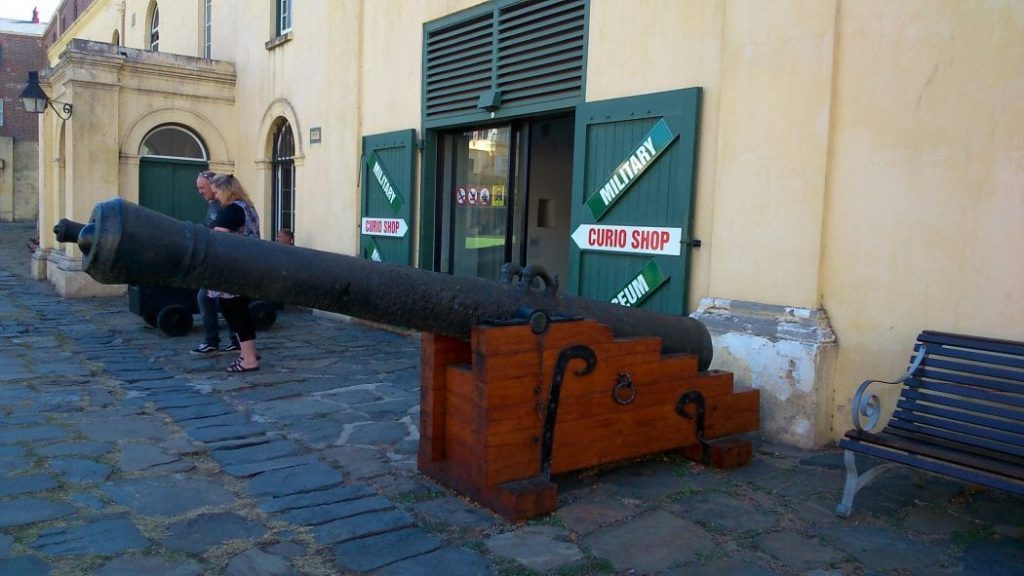
Aside from the lovely, little curio shop, which offers unique Castle curios – the Military Museum offers a wealth of displays.
These include impressive medals, badges, military books, Cape uniforms, small arms and sword collections. This display is hailed as one of “the most impressive in the country”.
Detailing Cape Military History
It also gives a great, detailed account of the Cape’s military history. (Though somewhat unrelated perhaps, there’s also a section that offers insight into South Africa’s ties to World War II and a section on Cape nature, if I recall correctly.)
There’s almost too much to take in during one visit, no matter how long you spend in there.
My personal highlights were the old weapons that have been so well-preserved; the amazing ship- and building-models; and finally, the excellent account of the 1806 Battle of Blaauwberg.
Meeting the Castle’s Guest Horses

After that, when I went back to the Outer Court, there were some lovely horses grazing the lawn.
One was a pony, while another was half-Boerperd, half-Percheron. The biggest guy of all was a beautiful grey Percheron gelding. I am used to big horses but he would put most to shame.

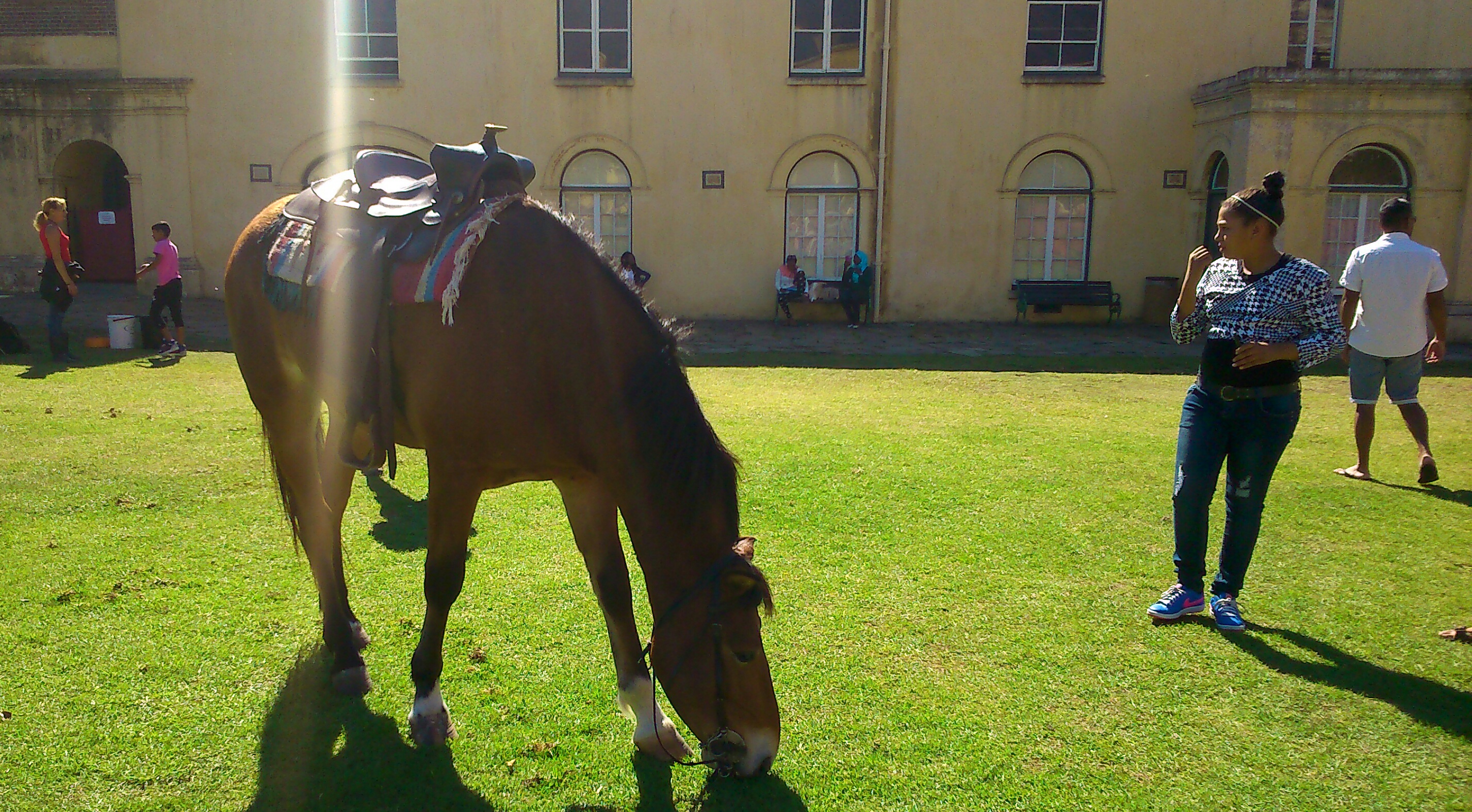

Most of the people were too nervous to go up to the grey gelding at first – so I decided to walk over to him and pat him on the neck and head to show that he was perfectly safe. After that, people eagerly flocked around him.
Visiting the Castle Restaurant
By this time, I was itching to visit the charming nearby De Goewerneur Restaurant (now Re5 Restaurant). So, to escape the midday sun and savour my last few moments at the Castle, I went there for a coffee break.
When I visited, they had a nice selection of food and drinks. However, I decided to just order the tasty ‘cake of the day’ and a great cup of coffee.
Just as I was sitting indoors, quietly and peacefully finishing off my meal, the cannon went off for the fourth and final time during my visit, sometime around or after 13:00.

After that, I went back to the gateway where my Freedom Day visit to the Castle had begun some five hours previously.
I carefully explored the herb garden/lemon grove, grassy surrounds and properly saw the ravelin and outer entrance (with the lion posts).

How My Castle Visit Rated
My first visit to the Castle was absolutely amazing. I thoroughly enjoyed it and came away with a better appreciation for and deeper understanding of my city’s vibrant colonial history, on a rather significant day in our country’s history.
I strongly recommend everyone visit the Castle. It is ideal for group of friends, tourists, school groups, couples and families and even solo travellers like myself.

Based on my experience, I give the Castle of Good Hope a firm 9/10 rating. (The only reason I can’t give it a 10/10 is because I haven’t yet seen all it has to offer due to the renovations. 🙂 )
General Information and Contact Details

Opening Times:
According to their website, the Castle of Good Hope is open Monday to Sunday, 9:00 am to 16:00 pm. (Last ticket sale is at 15:45 pm).
However, it is closed annually on Christmas and New Year’s.
Castle Tours:
Tours can be booked online. Please contact the Castle of Good Hope directly to enquire after or book a tour.
Contact Information and Address:
You can find the Castle of Good Hope at the corner of Castle and Darling Street, Cape Town, Western Cape, South Africa..
Contact number and email address:
+27 (021) 787 1260, marketing@castleofgoodhope.co.za.
Note: This post was originally published in 2015. However, I have done my best to update it and keep it relevant.
About the Author


The link to booking tours is not working.
Hi Julie,
Thanks for reaching out.
The link is loading perfectly when I try; it opens the ‘Contact Us’ page of the Castle’s website.
Please try again.
Regards,
Tamlyn.